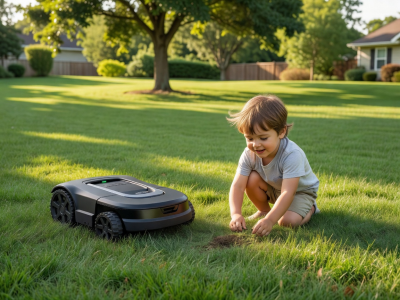
The idea of an autonomous machine with spinning blades wandering around a yard where children and pets play understandably provokes caution. However, robotic lawn mowers are statistically vastly safer than traditional push or riding mowers. They are designed from the ground up with redundant safety systems intended to neutralize the blade mechanism before human or animal contact can occur.
Understanding these integrated safety mechanisms helps clarify why safety agencies across the globe have certified these devices for unattended residential use.
The Blade Design: Centrifugal Force over Fixed Steel
The most critical safety feature of a standard robotic mower is the design of the blades themselves. Rather than a massive, fixed bar of heavy steel spinning with immense kinetic energy, the vast majority of robots utilize small, lightweight razor blades.
These blades are attached to a central spinning disc on a pivot point. Centrifugal force pushes the blades outward to cut soft grass. If a blade strikes something solid—like a shoe, a root, or a dog toy—the blade immediately folds back underneath the disc, rather than forcefully chopping through the object. This pivoting action minimizes damage and massively reduces the risk of serious laceration.
Redundant Sensor Systems
Beyond the mechanical design of the blades, multiple electronic sensors constantly monitor the physical state of the machine.
1. Lift and Tilt Sensors
If a child attempts to pick the mower up, or if the unit rides up a steep retaining wall causing it to tilt dangerously, integrated accelerometers instantly cut power to the cutting motor. The blade disc stops spinning in less than a second—long before fingers can slip beneath the protective outer shell.
2. Bump Sensors
The external chassis of a robotic mower essentially acts as a giant bumper. When the shell encounters physical resistance (a tree trunk, a garden gnome, or a sleeping pet), a micro-switch is triggered. The mower instantly stops the blades, backs up, rotates, and sets off in a new direction. The force required to trigger this bumper is generally quite low, ensuring it does not push over objects.
3. Active Avoidance (Sonar and Vision)
Premium models go a step further. Instead of relying on physical contact, they utilize ultrasonic sensors or artificial intelligence-backed cameras. These machines scan the terrain ahead and steer completely clear of obstacles, ensuring they never even bump into pets or yard debris.
Software and Operational Safeguards
Owners also have significant control over how and when the machine operates.
| Software Feature | Safety Benefit |
|---|---|
| PIN Code Lock | Prevents children or unauthorized users from starting the blades. |
| Scheduling | Allows operation only at night or during school hours when the yard is empty. |
| Geofencing/Alarms | Sounds a piercing alarm if carried away, deterring theft. |
Wildlife Protection
While robust against children and large pets, early models posed a risk to small nocturnal wildlife, specifically hedgehogs and frogs, which tend to freeze rather than flee when approached. The industry response has been widespread implementation of "Wildlife Avoidance Scheduling," which encourages owners to program the mower to operate exclusively during daylight hours, drastically reducing wildlife encounters.
Conclusion
When deployed properly and maintained according to the manufacturer's instructions, a robotic mower poses a fraction of the danger associated with conventional lawn equipment. The combination of pivoting micro-blades, instant-stop lift sensors, and customizable scheduling makes them a remarkably safe addition to the modern home.