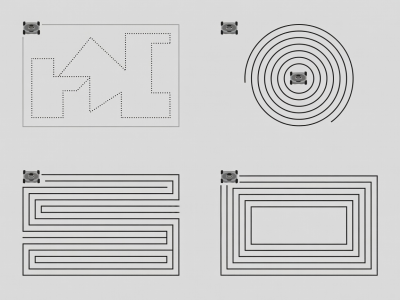
To an outside observer, a robotic lawn mower often looks like it is wandering aimlessly around the yard. However, beneath the plastic shell lies a sophisticated set of algorithms and sensor inputs dictating every turn. Understanding how these machines navigate is critical to selecting the right model for your specific landscaping needs.
Currently, the market is divided into two primary navigation philosophies: the traditional random algorithm and the newer systematic (or striped) pathing systems. Both rely on a variety of underlying technologies to determine where the boundaries are and how to handle obstacles.
The Random Path Algorithm
Despite the name, the "random" approach is highly calculated mathematics at work. When a mower utilizing this system encounters a boundary wire or a physical obstacle, it stops, reverses slightly, recalculates an angle based on internal logic, and sets off in a straight line until it hits the next boundary.
Over a predetermined period of time, this chaotic-looking pattern statistically guarantees that every square inch of the lawn will be cut from multiple different angles. This provides a carpet-like, uniform finish without leaving visible wheel ruts. Because this logic requires very little onboard processing power, it is the standard navigation method for nearly all entry-level and mid-tier models.
Systematic and Striped Navigation
Premium models have begun shifting toward systematic navigation. Using advanced positioning sensors, these machines know exactly where they are within the yard on a Cartesian coordinate system. They map the perimeter and then cut back and forth in straight, parallel lines, much like a human pushing a traditional mower.
Systematic pathing is notably faster. A machine cutting in straight lines can finish a lawn up to 30% quicker than a random-path model because it minimizes overlapping cuts. However, repeated travel over the same parallel lines can result in visible wheel tracks and grass compression, which is why systematic models often alter the angle of their stripes (e.g., cutting horizontally on Monday, vertically on Wednesday) to preserve turf health.
Sensory Inputs for Navigation
Regardless of whether the mower uses a random or systematic path, it requires physical and electronic inputs to understand its environment.
Boundary Wires vs. Virtual Boundaries
The traditional method involves a low-voltage wire pegged to the ground around the perimeter of the lawn. The mower detects the electromagnetic field emitted by this wire. When the sensors on the front of the unit read the signal, the drive motors instantly stop and turn the machine away.
Newer technologies use RTK (Real-Time Kinematic) GPS, combined with reference antennas, to create virtual boundaries. The mower navigates via satellite triangulation with centimeter-level accuracy, keeping it inside an invisible geofenced perimeter without any wires in the ground.
Bump Sensors and Accelerometers
What happens when a mower hits a lawn chair left in the grass? In traditional models, a floating shell rests on top of joystick-like joists connected to micro-switches. When the shell hits an object, it shifts, tripping the switch and triggering the evasive maneuver logic. Advanced mowers supplement this with sonar or camera vision, allowing them to detect the object and steer around it before physical contact ever occurs.
Choosing the Right Logic
If your lawn is flat, open, and lacks complex obstacles, a random navigation mower offers incredible value and leaves a flawless, cross-cut finish. If you have multiple acres, complex narrow corridors, or a desire for aesthetic lawn stripes, investing in a systematic, GPS-guided unit will yield significantly better results and faster cut times.