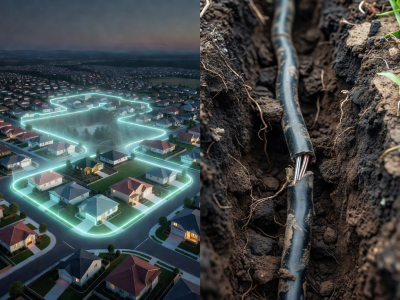
The most significant shift in robotic lawn care over the last five years has been the transition from physical boundary wires to virtual boundaries powered by RTK (Real-Time Kinematic) GPS. For anyone entering the market today, deciding between these two perimeter technologies is the most consequential choice you will make. Both systems have distinct advantages, and the right choice depends heavily on your property’s layout and your budget.
The Traditional Boundary Wire System
Boundary wire technology is the legacy standard of the industry. It involves running a low-voltage wire from the charging station around the entire perimeter of the lawn, pinning it to the ground (or burying it), and returning it to the station to create a closed loop. The base station sends a low-frequency radio signal through the wire, which the mower's sensors detect to know when to stop and turn around.
Pros of Boundary Wires
- Absolute Reliability: Once properly installed, a wire provides a hard, fail-proof boundary. It is not affected by cloudy skies, dense tree canopies, or tall buildings blocking signals.
- Lower Initial Cost: Models utilizing wire-based navigation are significantly cheaper to manufacture, placing them firmly in the entry-level and mid-tier price brackets.
- Simplicity: There are no software updates required to keep the perimeter intact. If the green light is on at the base station, the loop is closed and the mower will operate safely.
Cons of Boundary Wires
- Installation Effort: Laying hundreds of feet of wire and pegging it down is a laborious weekend project.
- Vulnerability to Breaks: Shovels, aerators, and burrowing animals can sever the wire. Finding the break in a buried wire can be highly frustrating.
- Inflexibility: If you redesign a flowerbed or add a patio, you must splice and manually reroute the physical wire.
The RTK GPS Virtual Boundary System
Wire-free mowers use a combination of standard GPS satellites and a localized reference antenna installed on your property. This RTK system corrects normal GPS drift, providing accuracy down to the centimeter. Instead of laying wire, you "drive" the mower around the edge of your property via a smartphone app to map a virtual geofence.
Pros of GPS Models
- Zero Wire Installation: Setup is done digitally in a fraction of the time it takes to lay a physical perimeter.
- Infinite Flexibility: You can edit boundaries, create temporary exclusion zones (like for a weekend party tent), or map pathways between separated lawn zones instantly via the app.
- Systematic Pathing: Because the mower knows its exact coordinates, it can cut in straight, efficient lines rather than bouncing randomly.
Cons of GPS Models
- Signal Blockage: Deep tree cover, narrow passages between tall houses, and steep retaining walls can block the satellite signal. When the mower loses its fix, it will stop and wait, requiring manual intervention.
- Cost: RTK technology and the associated processing power require a premium investment, often costing twice as much as a comparable wire-guided model.
| Feature | Boundary Wire | RTK GPS |
|---|---|---|
| Setup Time | High (4-8 hours) | Low (1-2 hours) |
| Tree Canopy Tolerance | Excellent | Poor to Moderate |
| Boundary Editing | Requires manual splicing | Instant via mobile app |
| Price Category | Entry to Mid-Tier | Premium |
Which Should You Choose?
If you have heavily wooded areas, large overhanging structures, or a strict budget, a boundary wire mower remains the safest and most reliable bet. However, if you have an open sky view, frequently alter your landscaping, and are willing to pay for convenience and efficiency, an RTK GPS wire-free model is an incredible leap forward in lawn care technology.